From the embarkation point to the contract, safety, fuel and the deposit: six practical checks to help you book with more information and avoid surprises.
Renting a boat is one way to discover Ibiza’s coast from a different perspective. But before booking, it is worth clarifying a few points that can prevent uncertainty, unexpected costs or terms that differ from what the customer expected.
Drawing on its experience renting boats in Sant Antoni de Portmany, Open Boats believes tourists do not need to become experts in maritime regulations to book with greater peace of mind. The most useful thing is to know what to ask, what to check before paying and what to check again before setting sail.
For those considering a boat rental in Ibiza, these are the practical checks Open Boats considers most useful.
1. The embarkation point: not every spot along the coast can be used to pick up customers
The place where a company picks up its customers is one of the first things worth checking.
When boarding takes place at a port, marina or yacht club where the company operates, the departure point is part of a regulated facility. By contrast, at a public jetty or another point along the coast, free access does not mean it can be freely used to embark and disembark paying customers.
Balearic Islands Decree 44/2025 requires the company to have the appropriate authorisation for the location where its activity begins or ends. Therefore, if pickup is proposed outside a port facility, a simple and useful question for the customer is whether that location is authorised for commercial embarkation and disembarkation.
Open Boats operates its departures from its base at Club Nàutic Sant Antoni de Portmany.
2. Ask for the contract in advance and check the registration number
The rental must be formalised through a contract. Rather than reading it quickly at the port, it is advisable to request a draft in advance so you can review the terms at your leisure and clarify any questions before the day of departure.
Among other things, check the price and services included, the fuel policy, the amount and terms of the deposit, the pickup and return times and locations, any late fees, the limits of the navigation area and liability for potential damage.
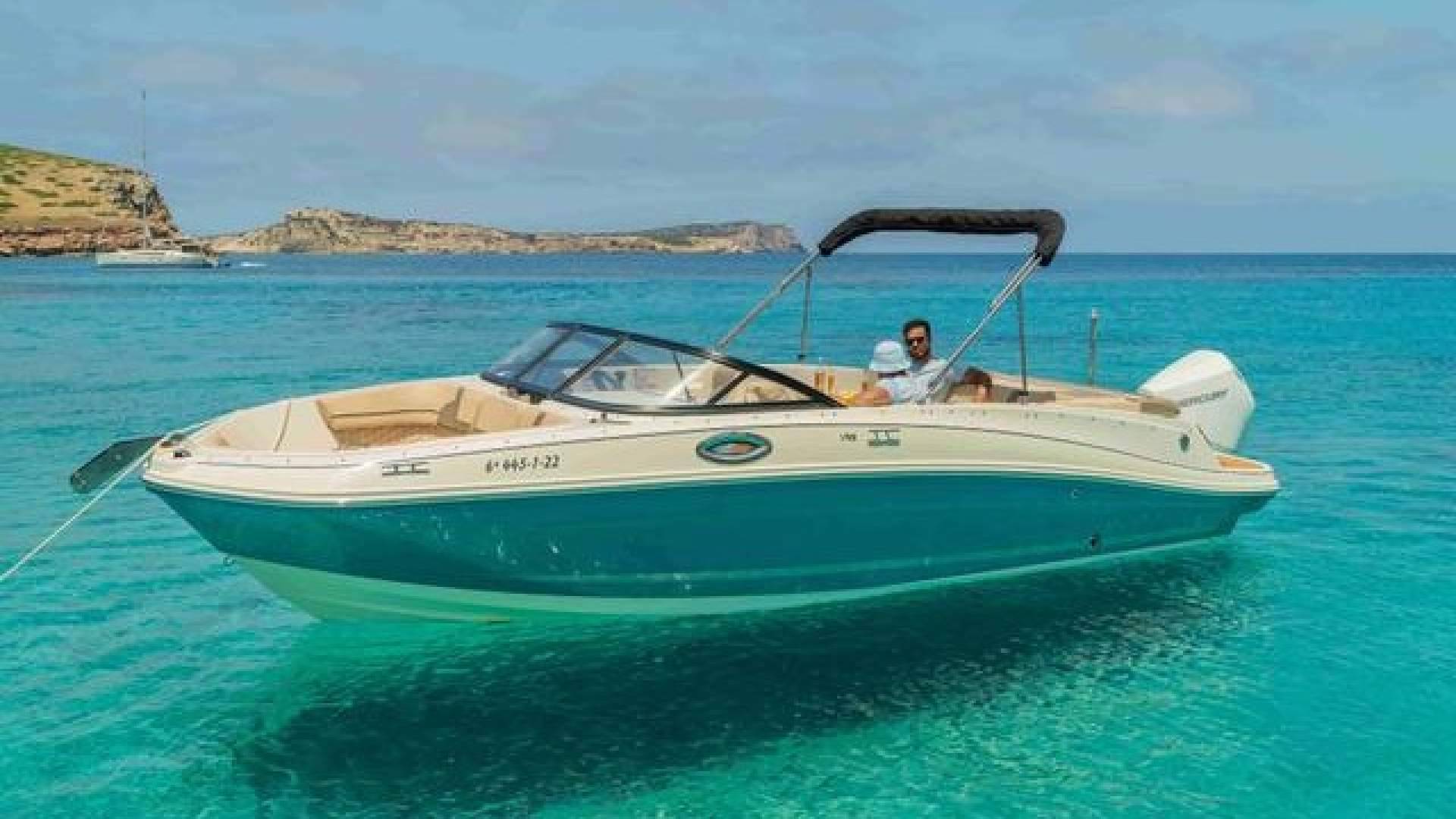
It is also important to clearly identify which boat is being rented. Check that the contract identifies the vessel and includes its registration number and, before setting sail, verify that it matches the boat provided.
Open Boats sends a draft contract with the booking confirmation email. Once formalised, the contract must be kept on board during the rental, either on paper or electronically.
3. Safety: you do not need to audit the boat, but you should know where the important equipment is
Personally checking all the equipment required by regulations on a boat is not realistic for most tourists. The required equipment depends on the characteristics of the boat and the navigation area. Verifying that every item is on board and meets the requirements would require knowledge of the regulations and fairly exhaustive checks.
The practical approach is to ask to be shown where any equipment you might need is located before departure.
If the trip is with a skipper, customers should at least ask to be shown where the life jackets are and have the basic safety instructions explained before setting sail.
If the customer will be operating the boat, they should pay particular attention to the location and use of safety equipment. In addition to the life jackets, it is also advisable to locate the fire extinguisher and distress signals, as well as the VHF radio when it is mandatory for the intended navigation area.
According to Open Boats, the idea is not for customers to check certificates or try to locate every item required by regulations, but to know where the essentials are and understand the basic safety instructions before setting sail.
4. Clarify how fuel is charged
Fuel can significantly change the final cost of a day on the water, so it is worth understanding the policy before booking.
Several pricing arrangements are common in the sector:
Full-to-full: the boat is provided with a full tank and returned with the same level.
Based on consumption: the fuel used is charged according to the company’s calculation method, for example based on hours sailed or distance travelled.
Fixed cost: an amount is set in advance for a particular route or service.
All-inclusive: fuel is included in the total price of the service and is not charged separately.
In the first two arrangements, fuel costs depend on usage and can therefore vary depending on the boat, route and sea conditions. It is therefore advisable to ask about estimated consumption before departure.
For private trips with a skipper, Open Boats offers a fixed all-inclusive price covering the boat, skipper and fuel. For rentals without a skipper, the company offers two options: full-to-full or a fuel charge based on estimated consumption according to the distance travelled. Some customers prefer to refuel themselves at the end; others choose to avoid the stop and possible wait at the fuel station and pay the estimated amount upon returning to the berth.
5. Ask about the deposit and check the boat’s condition
The deposit deserves its own section because it does not work the same way for every type of rental.
For rentals without a skipper, customers are commonly required to leave a deposit to cover potential damage. For trips with a skipper, the company may not require one or may request a smaller amount to cover potential damage to the upholstery or other parts of the boat, such as the kitchen or bathroom.
Before booking, ask how much the deposit is, how it is taken—for example, as a charge or a card preauthorisation—when it is released and under what circumstances it may be withheld in full or in part. If it is a preauthorisation, the time it takes for the funds to become available again may depend on the bank.
Before departure, it is also advisable to visually inspect the boat’s condition and document any existing damage. Open Boats recommends paying particular attention to the propeller, hull, upholstery and canopy, and reporting any damage before setting sail.
6. What a tourist can realistically check before booking
For a tourist, especially one visiting from another country, checking all of a boating company’s administrative documentation independently can be difficult and impractical. Declarations of compliance, authorisations and other documents can be complex to interpret for someone unfamiliar with the regulations.
Therefore, rather than trying to conduct an administrative audit, Open Boats recommends focusing on specific matters that any customer can check.
Before booking:
Check that the website provides clear information, contact details and rental terms.
Check that the booking and cancellation terms, fuel policy and deposit are explained in writing.
Make sure you know who is actually providing the service and whom to contact if a problem arises.
Use other customers’ reviews as a reference for the company’s service and transparency, without treating them as proof of administrative compliance.
Before boarding:
Check that the boat is the one booked and that its registration number matches the one in the documentation.
Ask for the terms of use and navigation limits to be explained.
Locate the basic safety equipment and make sure you understand the necessary instructions before departure.
Ask what the insurance covers and what financial liabilities you could face in the event of damage or incidents.
If a company avoids providing a contract, does not answer basic questions about fuel or the deposit clearly, does not identify who provides the service or changes the financial terms at the last minute, it is prudent to resolve those questions before paying. None of these situations alone proves that there is an irregularity, but each is reason to pause and ask for more information before booking.
About Open Boats
Open Boats is a boat rental company based at the port of Sant Antoni de Portmany, on Ibiza’s west coast. It offers boat rentals and private trips with a skipper, with different options depending on the boat and type of experience.