Opening a restaurant in premises without an extraction flue: technological solutions, possibilities and limitations
Comunicados | 25/11/2026 | 16:00 ·
Comunicae
Comunicados | 25/11/2026 | 16:00 ·
Comunicae
Expomaquinaria examines how advanced smoke filtration and purification systems, together with new food service models, can expand the possibilities for using commercial premises without a conventional extraction flue
Expomaquinaria examines how advanced smoke filtration and purification systems, together with new food service models, can expand the possibilities for using commercial premises without a conventional extraction flue
Finding suitable premises to open a restaurant, café or takeaway business is one of the biggest challenges facing entrepreneurs in the hospitality sector. Location, rent and the characteristics of the property are decisive factors, but one technical limitation can determine the viability of the entire project: "the absence of an extraction flue".
In established urban areas, historic centres, protected buildings and shopping centres, installing an extraction flue that reaches the building’s roof can present technical, financial or administrative difficulties.
In response to this situation, Expomaquinaria, a company specialising in professional equipment and technical solutions for the hospitality industry, examines the available alternatives and the possibilities offered by smoke treatment technologies for certain food service projects.
Is it possible to open a restaurant without an extraction flue?
The absence of a conventional flue does not necessarily mean that premises must be ruled out for every type of food service activity. However, it does not mean that installing a filtration system will allow any kind of hospitality activity to take place either.
Viability depends on various factors, notably the business model, food preparation processes, the power of the installed equipment, the emissions generated and the requirements set by the relevant authorities.
A café serving ready-prepared products does not have the same extraction needs as a restaurant specialising in grilled meats, fried foods or traditional cooking.
For this reason, Expomaquinaria recommends examining the technical characteristics of the premises before signing a lease, taking over a business or purchasing professional equipment.
The technological evolution of commercial extraction hoods
Conventional extraction hoods are designed to capture and expel the smoke, vapours and particles generated during food preparation.
However, advances in air treatment systems have made it possible to develop equipment capable of addressing different pollutants through several purification stages.
Smoke from a commercial kitchen is a complex mixture that can contain water vapour, grease, oils, airborne particles, odour-causing compounds and, when certain fuels are used, combustion by-products.
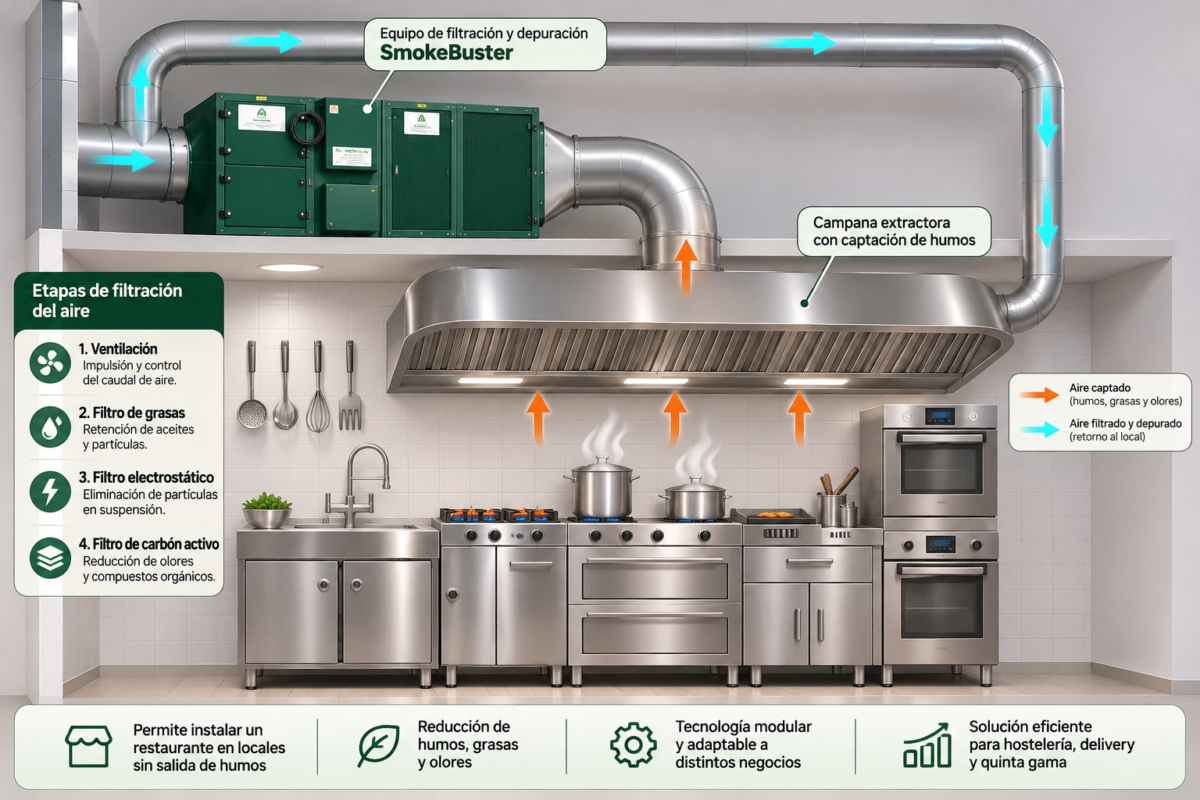
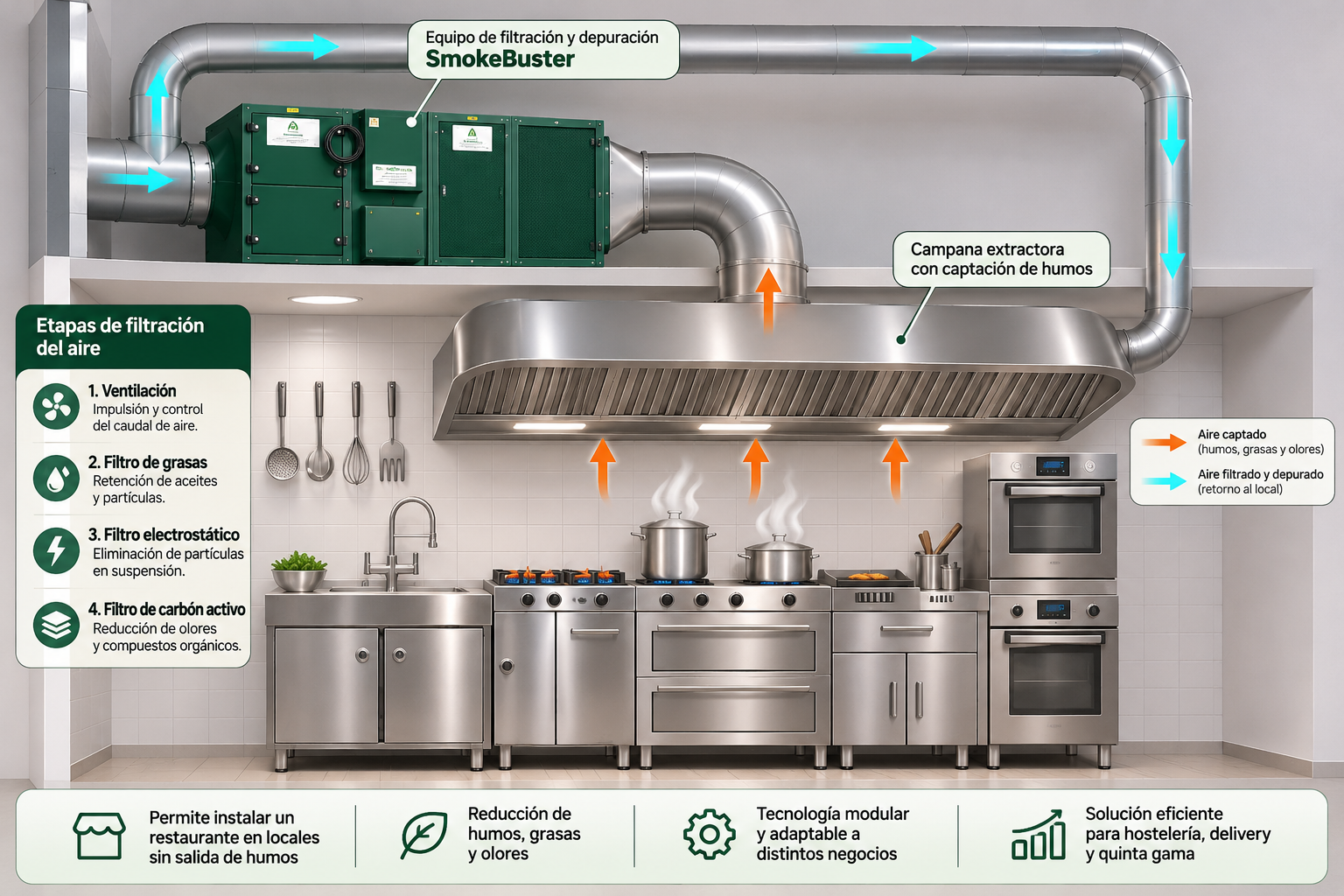
Eliminating or reducing these components requires specific technologies that go beyond the conventional filters in an extraction hood.
Notable systems currently available include:
Mechanical grease filtration: captures some of the grease and oils present in the extracted air.
Water filtration: uses water to help capture certain pollutants and reduce the temperature of the smoke.
Airborne particle purification: targets particles that are not captured during the initial filtration stages.
Activated carbon filters: help reduce certain odour-causing compounds.
Supplementary odour treatment systems: address specific purification needs, always under controlled operating conditions.
Combining these technologies makes it possible to configure systems suited to the characteristics of each installation.
SmokeBuster: technology applied to smoke treatment in the hospitality industry
Among the specialised solutions sold by Expomaquinaria is SmokeBuster, a modular smoke and odour treatment system manufactured by IberHostel and designed for professional use in the hospitality and food industries.
Unlike systems that use a single filtration stage, SmokeBuster combines different technologies to address the various components present in emissions from a commercial kitchen.
This technology can be considered for applications such as restaurants with inadequate extraction systems, food preparation facilities, establishments in shopping centres, satellite kitchens and certain food service models based on ready-prepared products.
The company offers different configurations of ductless extraction hoods for the hospitality industry, ranging from specific filtration systems to multi-stage treatment solutions.
The system must be selected according to the required extraction airflow, the type of cooking equipment, the emissions generated and the technical conditions of the premises.
In any event, installing a purification system does not automatically replace a flue when one is legally required.
New food service models that can reduce extraction requirements
Changing consumption habits and advances in food preparation technologies have encouraged the emergence of business models that may have lower extraction requirements than a traditional kitchen.
Concepts that can be considered for premises with technical limitations include:
Cafés and breakfast establishments.
Bars specialising in cold tapas and sandwiches.
Restaurants serving salads and cold dishes.
Sushi and poké establishments.
Prepared food takeaway businesses.
Restaurants based on ready-prepared products.
Satellite kitchens supplied by a central kitchen.
Establishments with limited food reheating processes.
The use of ready-prepared products, based on food that has been cooked in advance and prepared for reheating and service, reduces certain preparation operations within the establishment.
This model can help simplify facilities, staff organisation and process standardisation, although its administrative viability will still depend on the characteristics of the activity.
What are the limitations of a kitchen without an extraction flue?
Not all cooking processes are suitable for premises without conventional extraction.
Activities that generate large amounts of smoke, grease, heat or combustion products have more demanding technical requirements.
These include charcoal and wood grills, gas cookers, high-output deep fryers, solid-fuel ovens and certain roasting processes.
Likewise, using electrical equipment does not in itself guarantee that an extraction flue can be dispensed with. An electric griddle or deep fryer can generate significant amounts of greasy vapours, particles and odours.
The installation design must also account for general ventilation of the premises, air renewal, temperature and humidity control, fire safety and maintenance needs.
Smoke filtration and ventilation of the premises are complementary functions, but they are not equivalent.
Municipal regulations: a decisive factor
One of the main mistakes entrepreneurs can make is buying filtration equipment on the assumption that installing it will enable them to obtain an operating licence.
In Spain, food service establishments must comply with various technical, environmental and safety requirements, as well as the relevant municipal ordinances.
Spain’s Regulation on Thermal Installations in Buildings (RITE) restricts the recirculation of air extracted from spaces with high pollution levels, including commercial kitchens and extraction hoods.
Municipal authorities may also establish specific conditions for the evacuation of smoke, vapours and odours.
The technical solution must be assessed by a qualified professional, incorporated into the activity project where appropriate and brought into line with the requirements of the responsible authority.
For this reason, Expomaquinaria recommends clearly distinguishing between a system’s technological ability to purify air and the legal possibility of using it in a particular establishment.
Eight recommendations before renting premises without an extraction flue
To reduce the risk of making investments that cannot subsequently be put to use, Expomaquinaria offers the following recommendations:
Check municipal regulations before signing a lease or taking over a business.
Define the food service concept and the planned preparation processes.
Check whether there is an existing flue that can be used or whether one can be installed.
Assess the equipment, its power and the emissions generated.
Evaluate the available extraction, filtration and ventilation alternatives.
Seek advice from a qualified professional on the viability of the activity.
Include the costs of installing, operating and maintaining the systems in the budget.
Proper planning can prevent unnecessary renovations, subsequent changes to the project and expenses associated with purchasing unsuitable equipment.
"Many entrepreneurs rule out premises because they do not have an extraction flue, without first exploring all their technical possibilities. Today’s technology makes it possible to address situations that were difficult to resolve years ago. However, the success of a project does not depend solely on installing a good extraction hood, but on combining a suitable food service concept, a properly sized smoke treatment system and compliance with applicable regulations", — Juan Pedro Ruesca Ubide, Expomaquinaria.
Technology as a tool to expand opportunities in the hospitality industry
Advanced filtration systems and new food cooking and reheating technologies can help develop food service concepts suited to the characteristics of certain commercial spaces.
These solutions also offer an opportunity to explore bringing urban premises back into use where structural limitations make it difficult to accommodate traditional food service models.
The future of these installations lies in combining technological innovation, professional kitchen design, operational efficiency and regulatory compliance.
Interested professionals can find more information in the technical guide to ductless extraction hoods prepared by Expomaquinaria.
About Expomaquinaria
Expomaquinaria is a Spanish company specialising in hospitality machinery, professional equipment, commercial kitchen design and smoke and odour treatment solutions.
The company provides technical advice for new hospitality projects and the renovation of existing establishments, helping clients select the equipment best suited to the characteristics of each activity.
https://gironanoticies.com/en/opening-a-restaurant-in-premises-without-an-extraction-flue-technological-solutions-possibilities-and-limitations/