
|
Gastronomic beach bars with more attractive designs that blend into their surroundings, new parasol services and improvements to beach facilities are among this summer’s main highlights
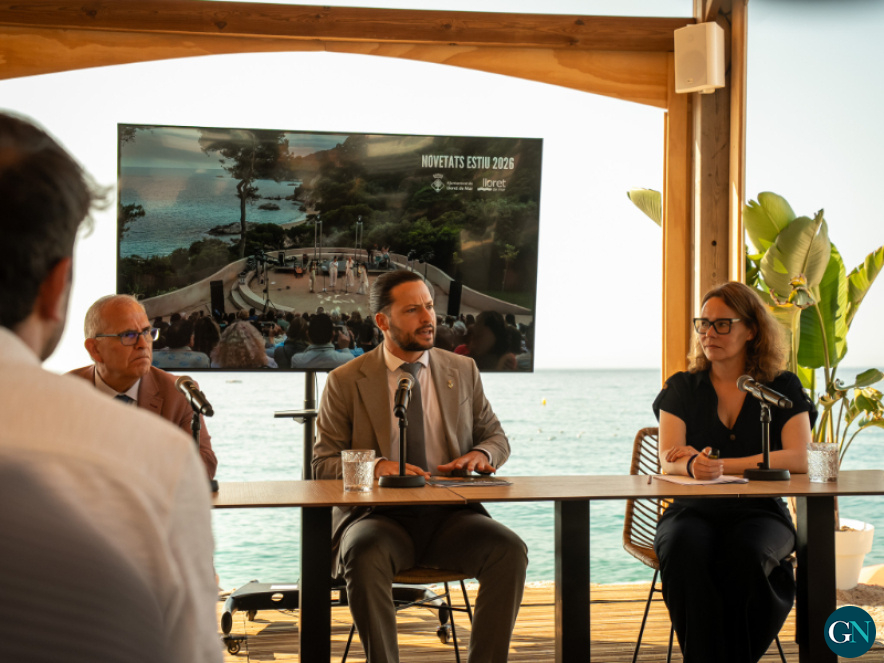
The Mayor of Lloret de Mar, Adrià Lamelas, accompanied by the Councillor for Beaches, Cristina Aymerich; the Director of Lloret Turisme, Elizabeth Keegan; and the President of the Hospitality Association, Enric Dotras, presented the main new developments for the summer at the Bonito Tú beach bar on Lloret Beach.
Lloret de Mar is beginning a new summer season with major changes and improvements to its facilities and services.
Lloret de Mar continues to invest in active, healthy beaches and coves, moving towards an urban beach model in which the visitor experience is adapted to new travel trends.
Lloret de Mar will have eight beach bars located across its different beaches and coves, all featuring significant improvements to their services and facilities. Three will be located on Lloret Beach, three on Fenals Beach, one in Cala Canyelles and one in Sa Boadella.
Following changes to the Beach Regulations, the beach huts on Lloret Beach, as is already the case on Fenals Beach and in the coves, will now be classified as bar-restaurants and will include a food service.
The beach bars will also feature aesthetic improvements, with a more attractive and harmonious appearance designed to blend into their surroundings, as well as the option of having an adjoining storage area.
The new image also brings a series of restrictions. The establishments will not be allowed to sell alcoholic drinks in containers larger than one litre or advertise special offers, price reductions or similar promotions for alcoholic beverages. Smoking any type of substance will no longer be permitted either inside the establishments or on their terraces.
The main change is that, following an agreement by the Beaches Committee, which includes representatives from all the municipality’s political parties, the way in which space is authorised for hiring sunloungers and parasols has been modified.
Operators will now be required to mark out their areas with ropes or other visible elements to prevent them from creating a barrier and to ensure that other areas of the beach remain unobstructed.
The sunlounger service is available on Lloret Beach, Fenals Beach, Santa Cristina Beach and Cala Canyelles. To improve their visual impact, the equipment has been renewed in sand-brown colours.
Many operators also provide complementary services and facilities for people with reduced mobility, including walkways and amphibious chairs.
In terms of beach surveillance, Lloret de Mar continues to have one of the longest lifeguard seasons on the Costa Brava. Lifeguards are present from 15 May to 15 October, as well as for 17 days during Easter.
During the peak season in July and August, the municipality’s beaches and coves will have a total of 25 lifeguards to ensure bathers’ safety.
As a major new development, Lloret Beach will also have a healthcare technician whose role will be to facilitate and promote the assisted bathing service for people with special needs.
Another improvement to the lifeguard service is the new rescue module in Sa Boadella. The facility contains two rooms: one dedicated to the needs of lifeguard professionals and another adapted to provide any care or assistance required by bathers and other users of Sa Boadella Beach.
Once again, all the municipality’s beaches and coves have received the Blue Flag distinction. Just a few days ago, Lloret de Mar hosted the ceremony at which these awards were presented in recognition of water quality, safety in bathing areas and the environmental management of Catalonia’s beaches and marinas.
The Blue Flags are awarded annually by the Association for Environmental and Consumer Education. Lloret retains all five of its Blue Flags for Lloret Beach, Cala Canyelles, Fenals, Sa Boadella and Santa Cristina.
Casa del Mar has also once again received the “Centre Blau” distinction for its year-round work to promote local ecosystems and raise public awareness of environmental issues.
Another of Casa del Mar’s functions is to promote Lloret’s natural environment. In recent years, it has worked with the Town Council to enhance the summer season by organising family activities, including guided daytime and night-time snorkelling excursions.
The Town Council continues to promote outdoor fitness facilities. The health park on Fenals Beach, designed for older people, has been improved with additional equipment.
A complete renovation of the workout area is also planned. This will be complemented by a new workout zone in the sports area featuring competition-standard equipment.
On Lloret Beach, sanitation facilities have been improved with the acquisition of three new prefabricated modules. In line with the Town Council’s policy of making beaches increasingly accessible to people with special needs, one will include an accessible toilet, a baby-changing facility and a special sink for cleaning ostomy bags.
In 2024, Lloret de Mar added a year-round ban on smoking, using electronic cigarettes or similar devices on beaches and in bathing areas to its Civic Behaviour and Community Coexistence Ordinance. These areas are now designated as smoke-free spaces.
The restriction also applies to beach-bar terraces. Its purpose is to protect the environment, provide cleaner public spaces free from smoke and cigarette butts, and promote civic coexistence and public health.
Lloret de Mar will have two community officers to carry out an awareness campaign and remind beach users of the regulations currently in force.
Another health-protection measure concerns the regulation of alcoholic beverages, not only at beach bars but also aboard cruise boats and catamarans.
Lloret de Mar continues to promote a tourism management model based on shared responsibility between the public and private sectors.
Several joint measures are being introduced this summer to strengthen coexistence, improve the quality of public spaces and protect residents’ right to rest, consolidating a pioneering model of shared responsibility for managing the destination.
This year, Lloret Turisme is launching an awareness campaign aimed at users of nightlife venues, highlighting the importance of respecting residents’ rest and reducing noise in public spaces.
Since 15 June, a language-targeted social media campaign has been running for young people from Germany, Poland, the Netherlands, France, Italy and the United Kingdom.
Nightlife venues have also been provided with an awareness video in which several older women from Lloret use humour to build empathy with young people and ask them to respect their need for rest.
As part of the “Sustainable Lloret” project, Lloret Turisme has launched a carbon footprint calculator for visitors who want to learn about the environmental impact of their stay in Lloret de Mar.
Through a short questionnaire, the digital tool calculates the carbon footprint of a holiday and offers users the option of making a financial contribution to local social and environmental sustainability projects.
The platform currently accepts contributions to the “Camina” programme, promoted by the Lloret Town Council’s Sports and Welfare and Family departments. The programme aims to guarantee access to physical activity for local children and young people aged between six and 18. Further projects will be added shortly.
The calculator can be accessed through various physical and digital platforms using QR codes. These can be found on the destination’s website, lloretdemar.org, at tourist information offices and in accommodation establishments.
For the third consecutive year, Lloret de Mar will deploy a team of information assistants under the agreement signed with the nightlife sector.
A total of 18 assistants will support the municipal security services in the Old Town, where most nightlife activities and the largest concentrations of people are located.
Their main role will be to inform and warn visitors, pedestrians and staff at local tourism and nightlife establishments about the regulations set out in the coexistence ordinance.
Although most will work night shifts, the afternoon service will also be strengthened in 2026.
Lloret de Mar will also have 112 Local Police officers during the peak summer season. Following the latest recruitment process, five permanent and 13 temporary officers have been hired. Ten of the temporary officers will have six-month contracts to reinforce the service during the summer.
There will also be three Civil Protection officers, four beach patrol officers and approximately twenty Proactiva lifeguards working on the municipality’s beaches and coves. They will be joined by an additional 35 Mossos d’Esquadra officers and eight National Police officers to guarantee security during the period of highest visitor numbers.
This summer, Lloret de Mar is launching the “Safe Taxi” campaign through a cooperation protocol between the Town Council and the local taxi association.
Its objective is to protect women travelling by taxi and ensure that female passengers reach their homes safely, especially at night.
Under the protocol, participating taxi drivers undertake to wait until the passenger has reached the door of her home. If they detect any unusual or potentially dangerous situation, they must contact the Local Police or the Mossos d’Esquadra immediately.
Participating taxis display a sticker reading, “When you reach your destination, I will wait until you are safely inside”, in Catalan, Spanish and English.
Until 27 September, residents and visitors will be able to enjoy a packed programme of concerts, fairs, family activities, celebrations, shows, nature experiences, open-air cinema and popular traditions.
One of the main new attractions will be the Candlelight concerts at the amphitheatre in the Santa Clotilde Gardens. Four concerts featuring reinterpretations of classical music by different ensembles will take place throughout July and August, accompanied by Candlelight’s characteristic candlelit atmosphere.
In addition to the Candlelight concerts, the Outdoor Summer Festival will once again offer a packed programme of cultural events from June until September.
Lloret Turisme and the Lloret de Mar Town Council have brought together in a single programme all the activities organised directly by the council, as well as those promoted by local organisations and the private sector.
Around sixty events will take place in total. The programme began on 6 June and will continue until 27 September.
One of the major highlights will be the centenary of the summer sardana programme. Another attraction will be the first edition of the “Temps Clotilde” concert series, held at the amphitheatre in the Santa Clotilde Gardens.
The programme will also include a new edition of the Clon Festival, the fifth edition of Pride Costa Brava, open-air cinema sessions, the On/Off Festival, the Diada Castellera, the Lloret Drone Festival and the Santa Cristina festivities.
These are just some of the activities that will fill the municipality’s streets with music, fairs, shows, family and nature activities, and popular traditions.
This summer consolidates one of the main transformations currently taking place in Lloret de Mar: the renewal of its visitor economy.
Over the past two years, the private sector has invested almost €150 million in modernising hotels, restaurants and leisure facilities, reinforcing a model that prioritises quality, innovation and sustainability.
This investment is allowing the destination to adapt its offering to changing visitor expectations and improve its competitiveness without relying on an increase in the number of hotel beds.
The transformation is the result of a shared strategy between the public and private sectors designed to generate greater value for the municipality as a whole.
For years, Lloret de Mar has been working to diversify its tourism products, extend demand beyond the main season and consolidate an increasingly specialised range of services.
The aim is to continue developing Lloret de Mar as a year-round destination, increase local spending, improve the customer experience and generate a more positive economic and social impact for both businesses and residents.
